You may have heard about context, graphs, and stories about AI agents. Usually impressive in PoCs but difficult to scale. In this deep dive, we’ll take you on a journey into what context means for AI agents, how creating a strong context layer can help your AI transformation scale sustainably, and why it is the missing layer that makes it all work.
Over the past year, we’ve worked with dozens of enterprises and more than 50+ senior IT leaders on their AI transformation. We asked them why AI stalls at scale, and the answer comes back in different words but with the same meaning: “Our AI is intelligent; it just doesn’t know our business.”
We heard versions of that sentence again and again. The industries differed, and so did the technology stacks, but everyone hit the same wall. The pilots work and the models are capable. What breaks at scale is that every new agent must be taught from scratch how the business fits together: What systems & processes depend on each other, which rules have exceptions, which decisions rely on knowledge that only exists in people’s heads.
Most enterprises have never called this a context layer problem. But if your AI programme is moving from proof of concept to enterprise-wide use cases, these challenges will probably sound familiar:
| Fragmented data and knowledge across systems limits AI at enterprise scale | Knowledge |
| AI pilots repeatedly rebuild integrations, context and governance instead of reusing them | Build Cost |
| Critical business logic, judgment and exceptions remain undocumented or trapped in people’s heads | Business Logic |
| Limited decision lineage: difficult to reconstruct what AI knew, why it decided and what it did | Traceability |
| Agents need broad context while still respecting permissions, policy and data boundaries | Governance |
| Repeated retrieval and oversized context increase inference cost as AI scales | Run Costs |
What is context, context graphs and context layer?
Let’s first define the core concepts related to context layer and differentiate what each component means.
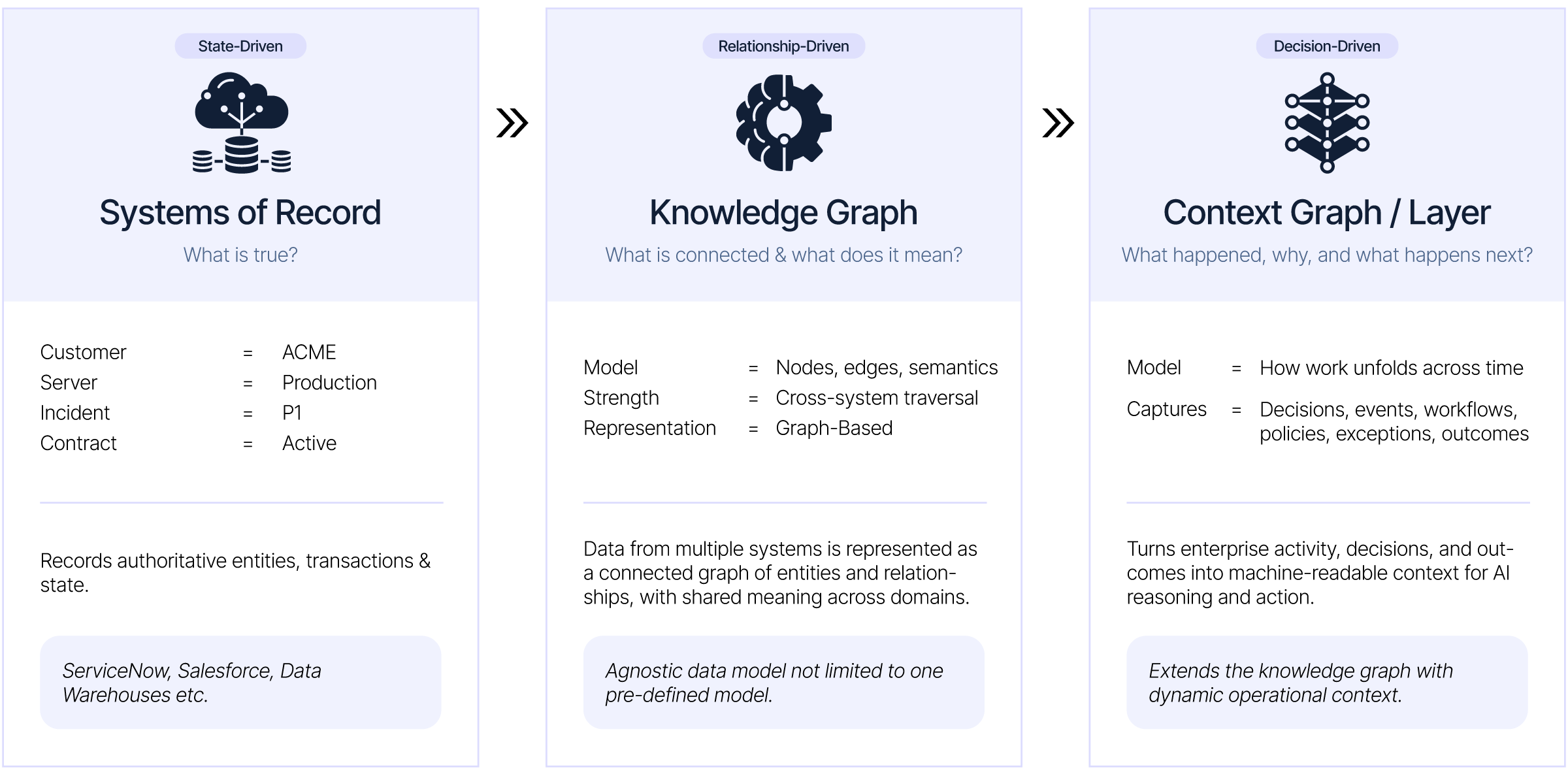
Context is the interconnected knowledge and information currently available to an AI model for reasoning and decision-making.
Examples:
- Decision traces (business, operations, finance, etc.)
- System instructions and records
- User messages
- Data retrieved from external sources
- MCP information
- Conversation history
- Files, notes, etc.
A context graph is a structured, queryable representation of an enterprise (configuration items, relationships, policies, tickets, users and temporal context) that an agent queries at inference time, rather than a static document store.
Components:
- Nodes (records, CIs, tickets)
- Edges (relationships), which the organization defines
- Properties (metadata)
Possible solutions:
- Graph databases, e.g. Neo4j and others
A context layer is an enterprise reasoning infrastructure that sits between AI models/agents and enterprise data and systems. It aggregates data sources and provides business meaning to support AI models in their reasoning.
Components:
- Context graph
- Governance, rules, permissions, ACLs
- Interfaces
Evolution of the context layer
What problems does the context layer solve?
The AI agents often lack access to the implicit business context and institutional knowledge that humans usually bring to decision-making. Encoding human judgement and interconnecting it with wider organizational perspectives solves your AI’s fragmented view of your enterprise.
A context layer therefore sits between your systems of record and any AI agent consuming it. For example, ServiceNow knows an application is down. HubSpot knows which invoices are queued. Only the context layer knows those two facts are tied to the same problem together with the decisions, regulatory norms/ SLA, exceptions and expertise around it.
Why is it important for AI?
Despite the attention AI receives, two challenges hold back enterprise-wide AI adoption: delivering meaningful business outcomes and trusting the results. A context layer addresses both. It gives agents the business understanding they need to make decisions that matter, and because every answer is built from traceable links, people can see the evidence with decision traces.
Even though the context layer is a fresh concept, it is gaining attention because it addresses a fundamental requirement: AI needs to understand the business it is expected to assist and transform.
A real business case
At 08:00, your invoicing platform goes down. Someone asks: how will this impact cashflow?
Without a context layer, this is a two-hour scramble across three teams without any actionable insight: some invoices will be late.
With one, the agent traverses the graph in seconds. From the ServiceNow service model and CMDB, it maps what the platform supports and which downstream workflows stop.
From HubSpot, it pulls the deals and invoices sitting in those workflows, with their terms and billing dates. It then joins the two. Three invoices are blocked, covering customers A, B and C, at €600,000 in total. Two of them sit on 30-day terms with slack in the schedule.
The third is dated today and belongs to a customer whose payment run closes on the 30th, so missing the send pushes that cash a full cycle rather than a day. That one invoice carries €410,000 of the €600,000, and it lands in the week you are forecasting against your revolving facility.
So the answer is not that €600,000 slips by a day. It is that two invoices can wait for the platform to come back, one cannot, and here is why.
The agent then proposes the actions that follow. Send the time critical invoice outside HubSpot through the email connector, leave the other two queued, and write the incident and the revised invoice status back to the graph so the next question asked about this customer already knows what happened.
Bottom line
Your systems already know the records of data. The context layer is what lets AI understand what it means. By connecting the knowledge scattered across your systems and people into one picture of how it all fits together. With it, your agents can weigh the wider consequences of a decision before they act, and you can see the reasoning behind every answer. It turns enterprise context into something machines can use, and it improves with every decision written back to it, within the rules you govern. That is the difference between the two-hour scramble and the answer that says which invoice cannot wait. Filtering the signal from noise.
Where to go from here?
A context layer is not a project you start with a graph database. Built too broadly, it becomes another data platform nobody uses. Built too narrowly, it is just one more integration. In our next deep dive, we’ll share a blueprint for getting the scope right: which use cases justify a context layer and which don’t, how to start small without rebuilding later, and the lessons early adopters learned the hard way.